Out of all the temples in Kyoto’s Arashiyama area, Tenryu-ji (天龍寺, Temple of the Heavenly Dragon) is arguably the most prestigious. Built on the original location of Japan’s first Zen temple, it was completed in 1345. Upon completion, it was immediately recognised as a masterpiece of Japanese Zen garden design and was designated the top of Kyoto’s five major Zen temples—a ranking it maintains to this day.

Over the years, Tenryu-ji has suffered eight major fires. The temple we see today is the result of reconstruction in 1934. Yet in spite of the destruction, it has preserved its essence, largely thanks to the outstanding design of its founding abbot Muso Soseki (夢窓疎石, 1275—1351), one of the most eminent Zen masters of his time.

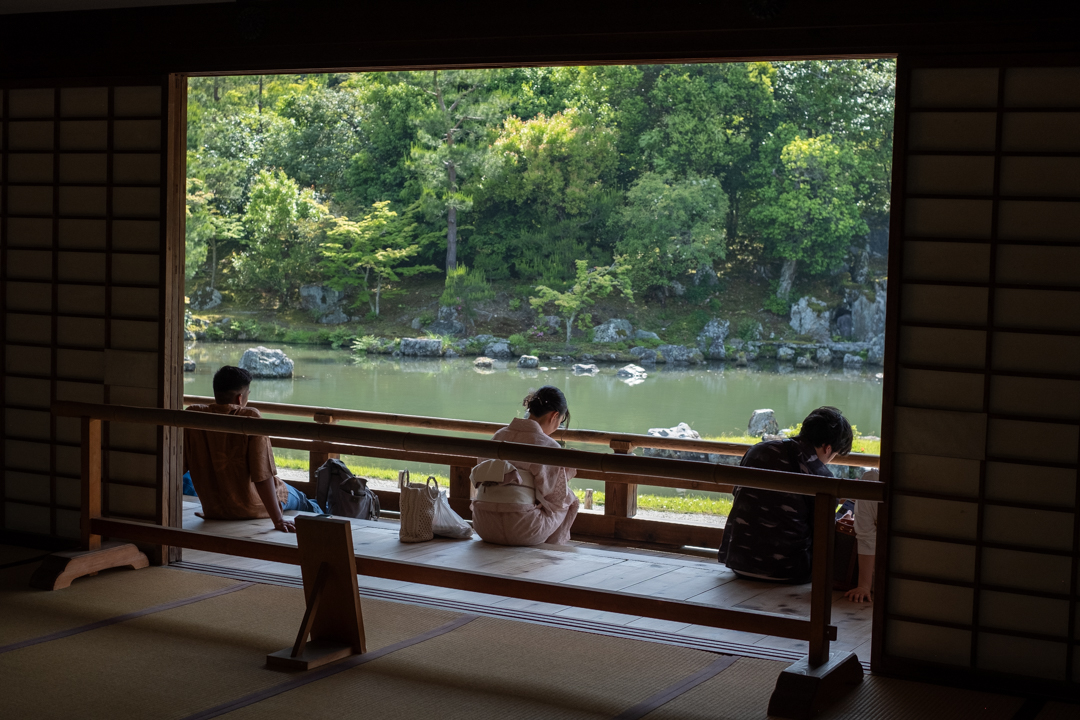
The veranda of the dharma hall faces the garden. As with most temples, you must take your shoes off to be able to walk inside the temple.
Zen Buddhism originated in China as the Chan school (禅宗), fusing Indian Buddhism with Chinese Taoist thought. It was introduced to Japan as early as the 6th century and eventually established itself as an independent school in the 12th century. Thanks to its emphasis on direct insight into the nature of one’s own mind in order to achieve enlightenment—without relying on religious scriptures—it became particularly popular among Japan’s noble and warrior aristocracy, the samurai class.

As a philosophical foundation, Zen Buddhism has exerted a strong influence on Japanese culture, while also bringing with it cultural practices such as the tea ceremony, flower arranging, martial arts, and garden and landscape design from China.

Sogenchi Teien
Tenryu-ji is an outstanding representative of Japanese Zen gardens. At its peak, the temple was an enormous complex comprising more than 100 sub-temples. Today, although its land area has been reduced to barely one tenth of its former size, the temple still retains its major structures, such as the Dharma Hall (the ceremonial hall), the Meditation Hall, and a large garden.

The pond is shaped like the upside-down Chinese character for “heart”(心). Source: Picture from the book 木骨禅心 by the author 王南
At the heart of the temple lies the Sogenchi Teien (曹源池庭園), a garden that was the first site in all of Japan to be designated by the government as a Site of Special Historic and Scenic Importance.
Seen from above, the pond has the shape of a reversed heart character (心). In Buddhism, the heart and mind are considered one and the same.
Before entering the garden, you may come across introductory materials describing it as a “stroll garden” (回遊式庭園). But what exactly does that mean? A stroll garden is a major garden type whose design principle was inspired by classic Chinese scroll paintings. Unlike the spatial projection in Western oil paintings, figures and objects in Chinese scrolls generally appear “flat”—the observer’s perspective shifts as the scroll unrolls, as if revealing a landscape that keeps expanding.

The rock formation is visible on the other side of the pond. Are you able to spot the carp stone?
The same principle applies in stroll garden design, where the visitor adopts a constantly changing perspective: with every step, a new scene—or the old scene from a new angle—unfolds before the eyes. The challenge in designing such gardens is easy to understand: the architect must consider the interactions among different elements, not from one fixed viewpoint, but from a sequence of shifting perspectives. In other words, instead of creating a static drawing, the designer is working on a canvas that keeps expanding and unfolding.

The carp stone can be seen in roughly in the middle of the rock formation. Source: Picture from the book 木骨禅心 by the author 王南
Sogenchi Teien is such an example. All the elements around it are carefully placed to create this effect, so that walking into the garden becomes part of the experience. This added layer of interaction makes the visit more fun and engaging.

The absolute highlight of Sogenchi Teien is the standing rock arrangement across the pond, facing the ceremonial hall. The large rocks represent a great waterfall, with a carp in the middle, behind a stone bridge. According to Chinese legend, any carp that leaps over such waterfalls transforms into a dragon—a story used to encourage perseverance and diligence in the pursuit of enlightenment.

Corridor leading to other parts of the temple grounds
In fact, the stone arrangement of a “climbing carp scaling waterfalls” is not uncommon in Japanese gardens. What sets Sogenchi Teien apart is that instead of placing the “carp” stone at the foot of the waterfall, it is placed in the centre among the “waterfall” stones, representing the carp in the very process of transforming into a dragon—the triumphant moment when success is finally at hand. For the illustrious aristocratic visitors of the past, such an auspicious sight would have been both pleasing and uplifting.

If you have time to visit Tenryu-ji, spend some time observing the stone arrangement from the veranda of the ceremonial hall, and see if you can sense the waterfalls captured in the stones.
At the end of the corridor from the dharma hall you’ll find Tahoden—a shrine dedicated to emperor Go-Daigo Bamboo forest Good luck charm decorated with a rising dragon


If you are in the mood for a souvenir, look no further than the ticket office. Here you can find Japanese Omamori (御守, meaning “protection”)—ornamental charms believed to bring blessings and good luck. In the same spirit as the “climbing carp” in the stone waterfall, you can find Omamori decorated with patterns of “rising dragons,” symbolising progress, promotion, and advancement. Good moods and high spirits are such miraculous things—the more you share, the more you gain. Perhaps this is yet another reason why Tenryu-ji remains so popular and lively.